

I first glimpsed Walter Rodney’s book How Europe Underdeveloped Africa as I snooped around my grandfather’s library as a curious teenager a few decades ago. Yet, I consciously shied away from reading it because I worried the book would absolve Africa of any responsibilities for its current developmental status.
And now, having read the book and re-read bits and pieces of it over the past few years, here are a few standout points for me:
The Manipulation of African Taste
This is not explicit in the book, but if you read between the lines, you would find it there.
From the very onset, one catalyst that facilitated Europeans access into Africa was the ability of the former to change the tastes of the elites in the latter. When I say taste, my definition is not limited to the sensations your tongue picks up when you put food in your mouth. Instead, it also comprises the whole process of how people evaluate what is good and what is desirable. European contact with Africans did just that – it shifted the tastes of the Africans in every sense of the word.
Consider the following quote in the book from Estaban Montejo, an African slave who escaped a Cuban slave plantation in the 1800s:
“It was the scarlet, which did for the Africans; both the kings and the rest surrendered without a struggle. When the kings saw that the whites were taking out these scarlet handkerchiefs as if they were waving, they told the blacks, ‘Go on then, go and get a scarlet handkerchief’ and the blacks were so excited by the scarlet they ran down to the ships like sheep and there they were captured”
African tastes shifted so much that a cloth dyed in red was deemed so valuable that it could be exchanged for a whole agentic human being!
Now, did Europeans introduce the concept of slavery to the African tribes they encountered? No, of course not!
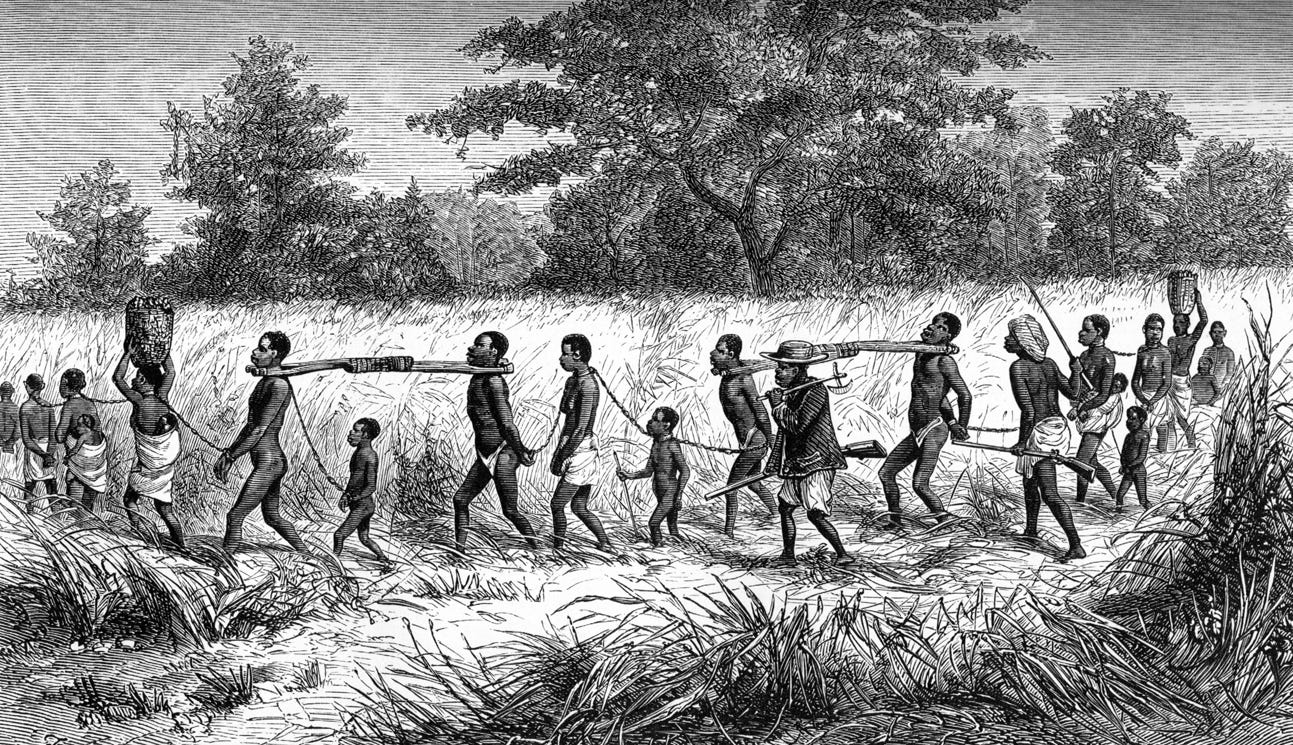
Historically, tribes in Africa, like in every other continent on earth, had periods of war and conflict. Stronger groups captured weaker ones, and likely had them killed to prevent retaliation. Somewhere along the line, the stronger groups realized that these captives were a source of free labor that could be used for grueling farm and construction work. In other places, such as Ibadan in modern-day Nigeria, these captives could be integrated into their captors’ army as soldiers where they later got access to their own farmlands as rewards for successful military campaigns. Essentially, a standout feature of African slavery prior to European contact was that manpower with actual or potential productivity was merely displaced within the continent, rather than outrightly removed from it.
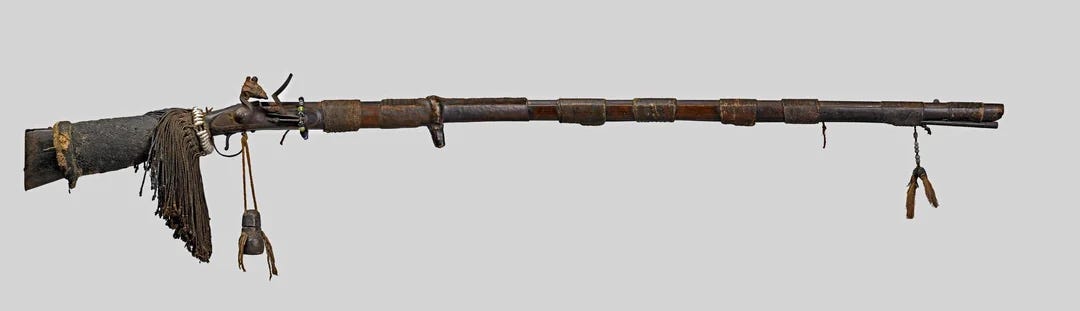
When the Europeans entered the picture, they came to trade with commodities like imported clothes, glass beads, gin, and later, firearms. The African elites who consumed these commodities deemed them very valuable and were willing to do anything – not minding the costs – to amass more of these goods. As it turned out, the cost was slaves. As their tastes had shifted, the African elites were mostly blind to the depletion in human labor consequent on their continued participation in the slave trade until it was too late.1
Second- and Third-order Effects of Acquired Taste
I think the acquired taste for imported commodities among the African elites also paved the way for the adoption of imported beliefs and value systems. After all, if one thinks imported goods are superior to local ones, it’s not a far cry to also think that imported values are superior to local ones.
There are at least two second-order effects that follow from this.
First, embracing imported values may have contributed to the decline in malevolent practices grounded in superstitious beliefs in certain regions of Africa, such as the infanticide of twins. Regardless of the local logic behind the tradition of killing twins, all things being equal, the cessation of such practices was a good thing.
The adoption of imported values, through an European school curriculum, also led to the establishment of an educated African middle class. This middle class were able to read and write and the power of literacy is transformational for any society. That said, it didn’t end there. Instead, the educated Africans started perceiving themselves as Europeans. Consider this excerpt from the book:
“According to official Spanish sources, it is said that the school system in Spanish Guinea achieved all that the colonizers expected of it. It produced the required Africans who loved Spaniards more than the Spaniards loved themselves, but it produced no opponents of the colonial regime”
This is mind-blowing! Through the educational system, Europeans were able to shape the minds of Africans to the point that the latter saw the former as a standard to aspire towards. European values were so deeply entrenched in educated African minds that at some point, they even started seeing themselves as superior to the illiterate African – just as the Europeans did!
So, the new hierarchy was: European → Educated African → Illiterate African.
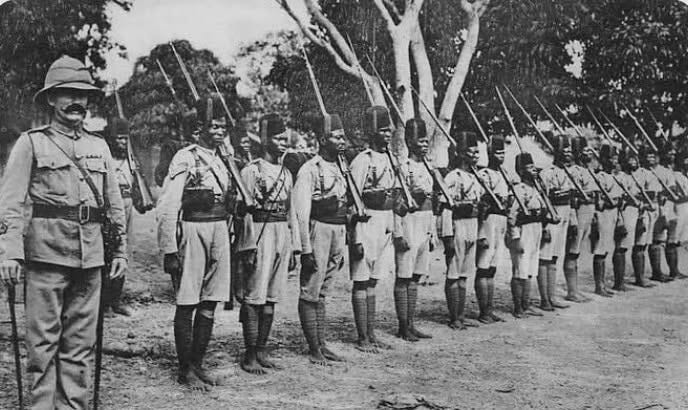
As the educated Africans continued adopting European values, a third-order effect that may have blindsided the European powers-that-be began to emerge: Initially, European colonial administrators had the intention of incorporating educated Africans into their colonial infrastructure on the continent given how expensive it was – in money and in blood – to have many Europeans in the colonies. In practice, this meant that educated Africans could do nothing more than serve as infantrymen,2 clerks and interpreters for the European administrators.
Eventually, opportunities arose for a subset of Africans to further their education in Europe.3 In the course of their studies, these Africans were exposed to the ideals of classical liberalism, such as rights to liberty, equality under the law, and so on. They realized that these ideals were meant for all of mankind, not just for Europeans. Educated Africans acquired a taste for these abstract values which culminated in the nationalist movements for independence in the late 1950s and early 1960s.
The Tragedy of Interrupted Development
Although it started off as fairly equal-footed4 , the trade between Europeans and Africans eventually devolved into a relationship where the Europeans were getting the better part of the deal. This is because the trade gave Europeans were getting what economic historians call ‘productive stores of value’, such as gold5 and slaves, while Africans were getting non-productive stores of value like cowrie shells picked from the Maldives. Over years, it’s easy to see how this compounded to leave Africa with the shorter end of the stick, developmentally.
Walter Rodney notes:
“What then is economic development? A society develops economically as its members increase jointly their capacity for dealing with the environment. This capacity for dealing with the environment is dependent on the extent to which they understand the laws of nature (science), on the extent to which they put that understanding into practice by devising tools (technology), and on the manner in which work is organized”
The Africans sold during the Slave Trade were human beings who could contribute to their local economy and had the capacity to think, tinker with their environments, and come up with innovative ways to improve their lots in life. In a sense, Africa suffered a double whammy: First, productivity dropped because people were more on their guard. A person who is always looking over his shoulder for slave raiders is not the kind of person who will spend time farming or tinkering with their environment. Second, the slave trade would have had a silver lining if the slaves were sent to other parts of Africa to develop the economic infrastructure there. For the most part, that wasn’t the case, as purchased Africans were sent to work on plantations in the Americas.6
For the Europeans, the story couldn’t be more different. By extracting from Africa and interrupting the continent’s path to development, Europe had access to the resources that lifted a good proportion of its population above the level of subsistence. As they were no longer struggling to have their basic needs met, European societies could afford to allocate more people to be scientists and thinkers, which, in turn, fostered innovation. In a roundabout way, while Walter Rodney’s “How Europe Underdeveloped Africa” could as well be called “How Africa Developed Europe”. With African slaves working the plantations in the New World, and African gold powering European banks, Europe thrived. The following quote from the book concretely shows how:
“Some of the biggest “names” in the colonial epoch were capitalist concerns whose original capital came from the trade in slaves or from slavery itself. Lloyds, the great insurance underwriting and banking house, falls into this category, having been nourished by profits from the slave territories of the West Indies in the seventeenth and eighteenth centuries; the ubiquitous Barclays Bank had its antecedents in slave trading”
The bottom line is that European societies had increased bandwidth to tinker with their environment on account of exploiting Africa, leading to their accelerated development.
The Myth of Atavism
A final point I’ll discuss is the concept of atavism – a word I learned from reading this book. Atavism is the idea that certain people are inherently savages, and no matter how civil they might appear in society, once the civilizing influence is removed, they revert to savage nature. In other words, Europeans saw themselves as a civilizing force in Africa, and because they were pushed out, Africans reverted to their animalistic tendencies. This was a racist idea that Europeans had about Africans and the challenges many African countries faced (and are still facing) in the post-independence era were used as evidence of the credence of atavism.
One thing that the proponents of atavism overlooked is the amount of time it takes for a society to evolve. At some point in their history, European societies had tribes, and over the course of hundreds of years, tribal loyalties gradually morphed into loyalty to nation-states. Someone born in Wessex in the mid-600s, for instance, would not have considered themselves English. This person’s loyalties would have been to the Wessex tribe even though there were other Anglo-Saxon tribes on the British Isles. It wasn’t until the mid-to-late 900s – nearly three centuries later – that individual loyalties to the kingdom of England started to emerge. That loyalty has been culturally transmitted, in some shape or form, across generations for the better part of a millennium, and as a result, someone born in Wessex today would see themselves as English first, rather than Wessexian.
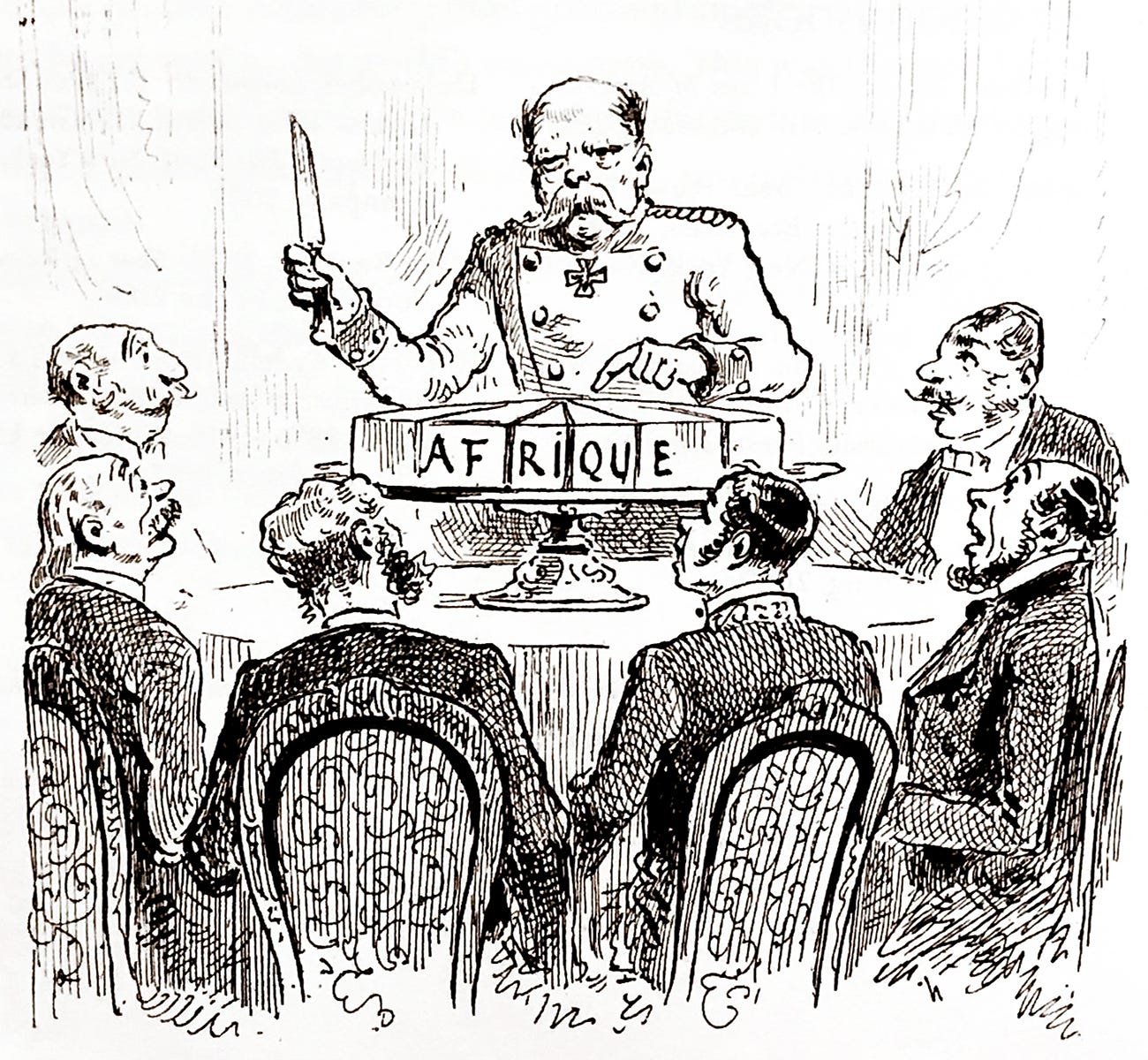
Now, contrast that with what played out in Africa. Because of the traumatic interruption from Europe, Africans were not afforded the long historical time it took to naturally progress from tribal loyalties to developing loyalties to nation-states. European powers used political maneuvering – and when necessary, military force – to force Africans into artificial, geopolitical contraptions assembled by drawing arbitrary lines on a map without any knowledge of the local realities. The African countries were, for the most part, an imposition on the local people. Compared to the hundreds of years that Europeans had to cultivate national loyalties, Africans had roughly 80 years to achieve the same thing.7 Given this context, it is no surprise that many African nations, post-independence, crumbled along tribal lines. This was not because Africans reverted to a savage nature after the “civilizing” hand of the Europeans was removed. Rather, it was because Africans did not have the time to cultivate loyalty to a nation they had little agency in putting together in the first place.
The same thing is still happening today. Many Nigerians today don’t like local rice – their tastes have shifted to imported rice. I also have a contact on WhatsApp who always markets dogs. He is not marketing local dogs, but imported Cane Corsos. These dogs go for crazy prices – three to five million naira for a dog! For context, the minimum wage in Nigeria is ₦77k and median wage is less than ₦200k
When you read the stories of European military exploits in Africa, it often sounds like it was the Europeans doing the actual fighting. However, while reading this book, I learned for the first time that the bulk of the "European" forces were literally Africans. They were equipped with European ammunition and uniforms, and they launched the attacks. The number of Europeans on the ground in Africa was actually very small. Every time they tried to venture beyond the shores of Sub-Saharan Africa, they died as they had no immunity or treatment for the local diseases.
This played out more in the British colonies
At first, African elites were able to play different European parties against each other in other to get the best deals
At some point, nearly 30% of the gold used in Europe was mined in Africa
African slaves were initially sent to work on extractive sugar plantations on the islands in the Bight of Biafra, as the Europeans were fine-tuning their plantation model.
Starting from the Berlin Conference in 1884-1885, which formalized which slice the European powers got out of the African pie, to Ghana’s independence from Britain in 1957, which started off the era when European colonization ended in several African countries