

In early November 2025, there were news reports circulating that the United States government under President Donald Trump was considering a limited military intervention in Nigeria to help crack down on inter-religious violence in northern and central Nigeria. By December 2025, the US followed through with its proposed intervention and launched airstrikes against Islamic State militants in northwestern Nigeria.
Naturally, there have been mixed reactions to this intervention. On the one hand, some saw it as an encroachment on Nigeria’s sovereignty which might have potential unintended consequences for both Nigeria and the US down the line. On the other hand, many welcomed it as a decisive step towards ending religious persecution and other forms of violence in northern and central Nigeria.
Much of the conversation online about the US military intervention in Nigeria has been dominated by social media discourse and global media narratives which often frame these issues through partisan or global politics lenses rather than through the perspectives of ordinary, everyday Nigerians. This study is an attempt to change that by centering Nigerian voices in this debate.
Measuring Nigerians’ Demand for US Military Intervention
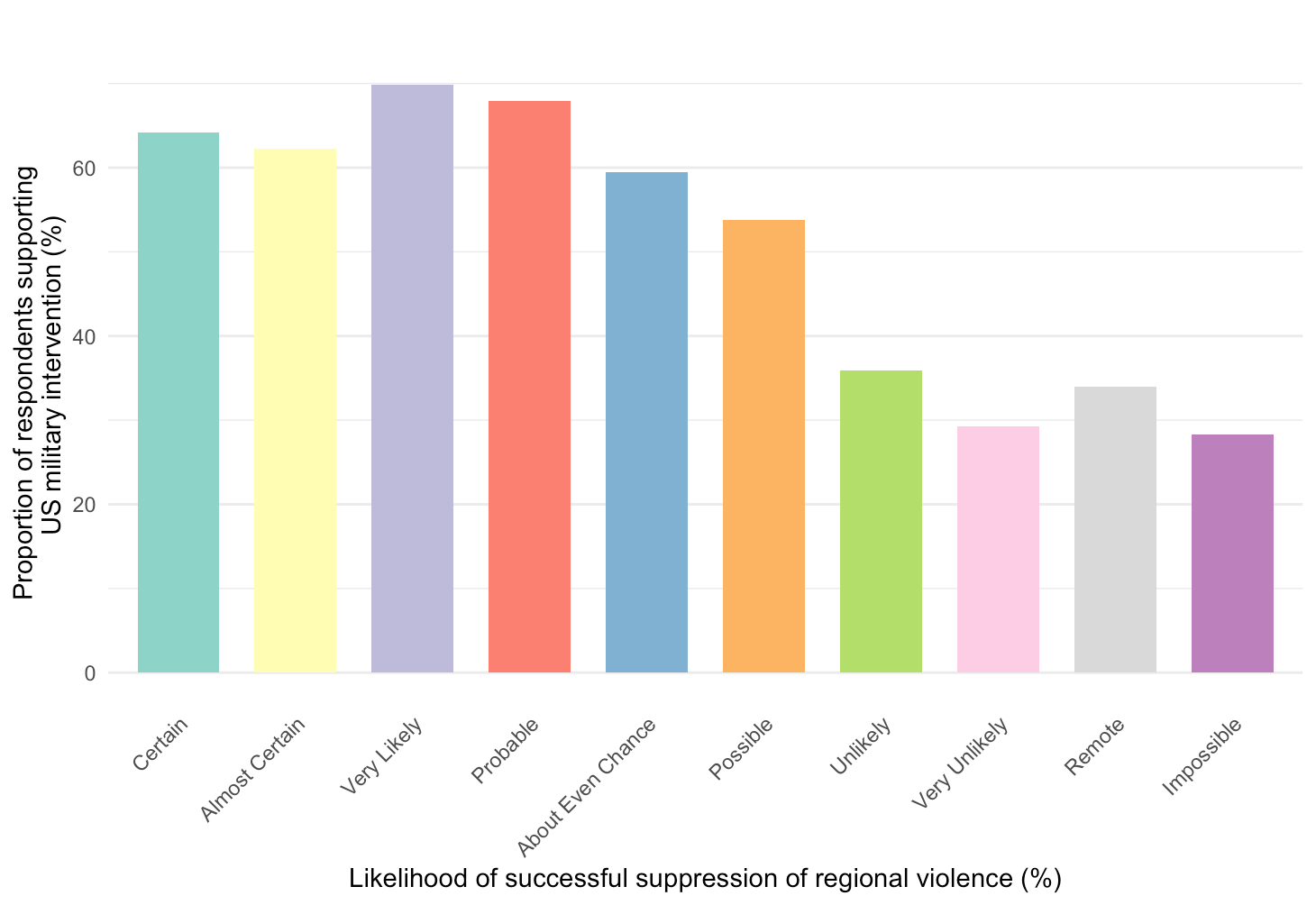
Following reports of the proposed intervention in November 2025, our team at PROMISE Labs Africa immediately got to work. We designed a short survey presenting 10 different likelihoods of successful suppression of regional violence in Nigeria on account of US military intervention. The likelihoods ranged from ‘Certain’ (100%) to ‘Impossible’ (0%) and were arranged in descending order in the survey.
The bar chart below aggregates the pattern of responses we got from 106 Nigerians who completed the survey:
Here’s the same data presented as a demand curve which makes it a bit easier to analyze:
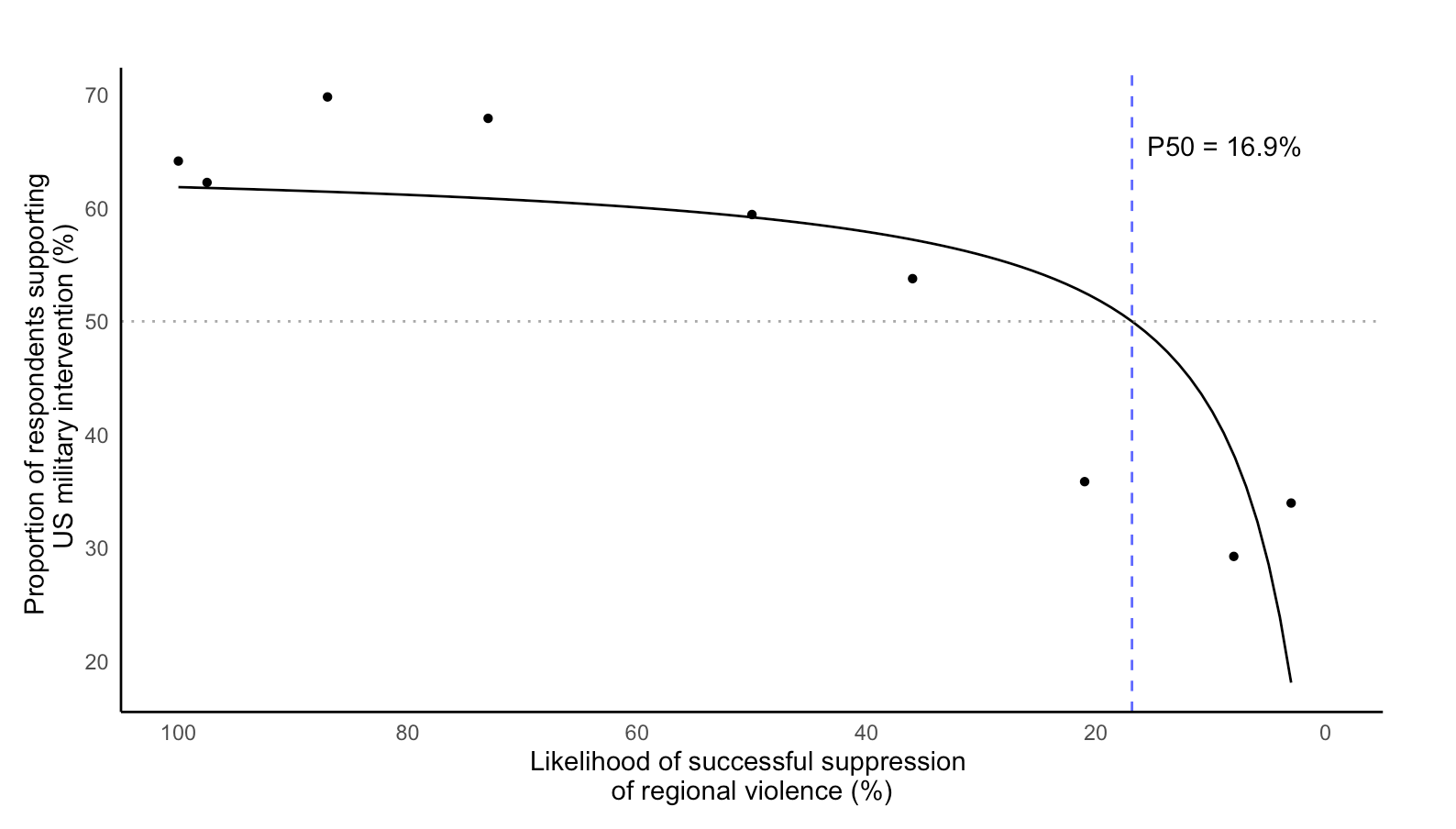
As you might expect, at higher likelihoods of success, many participants say ‘Yes’ and as the likelihoods decrease, more participants start to say ‘No’. We can also see the vertical dashed P50 line which, in this analysis, we are using as a proxy for measuring how much this group of participants will tolerate US military intervention even as the likelihood of its success drops.
Three quick observations based on Figure 1 and 2:
First, you can see how there was a marginally higher proportion saying ‘Yes’ to ‘Very Likely’ and ‘Probable’. Some of this can be explained by the small proportion of respondents who were inattentive and were just selecting haphazardly. However, as we would soon see from the interviews we conducted, some of the participants actually had rationalizations for selecting ‘No’ at ‘Certain’ and ‘Almost Certain’ before starting to select ‘Yes’.
Secondly, you may be surprised that even at 100% likelihood of success, the proportion of respondents supporting US military intervention in Nigeria never reached 100%. This is because a good number (about 18% of our respondents, mostly resident in northern Nigeria) rejected the US military intervention at ALL likelihoods of success. We’ll meet a few of them in the interviews we conducted.
Thirdly, even at extremely low likelihoods of success, we had a subset of our respondents still supporting US military intervention. These were from those participants (about 16% of our respondents, ALSO mostly resident in northern Nigeria) who accepted the US intervention at ALL likelihoods of success. We’ll also meet a few of them in a bit.
Before we see what individual participants had to say about their demand for US military intervention in Nigeria, let’s first break the survey data down by demographic group.
Subgroup Analysis of Our Sample
Here’s what we found from the subgroup aggregates:
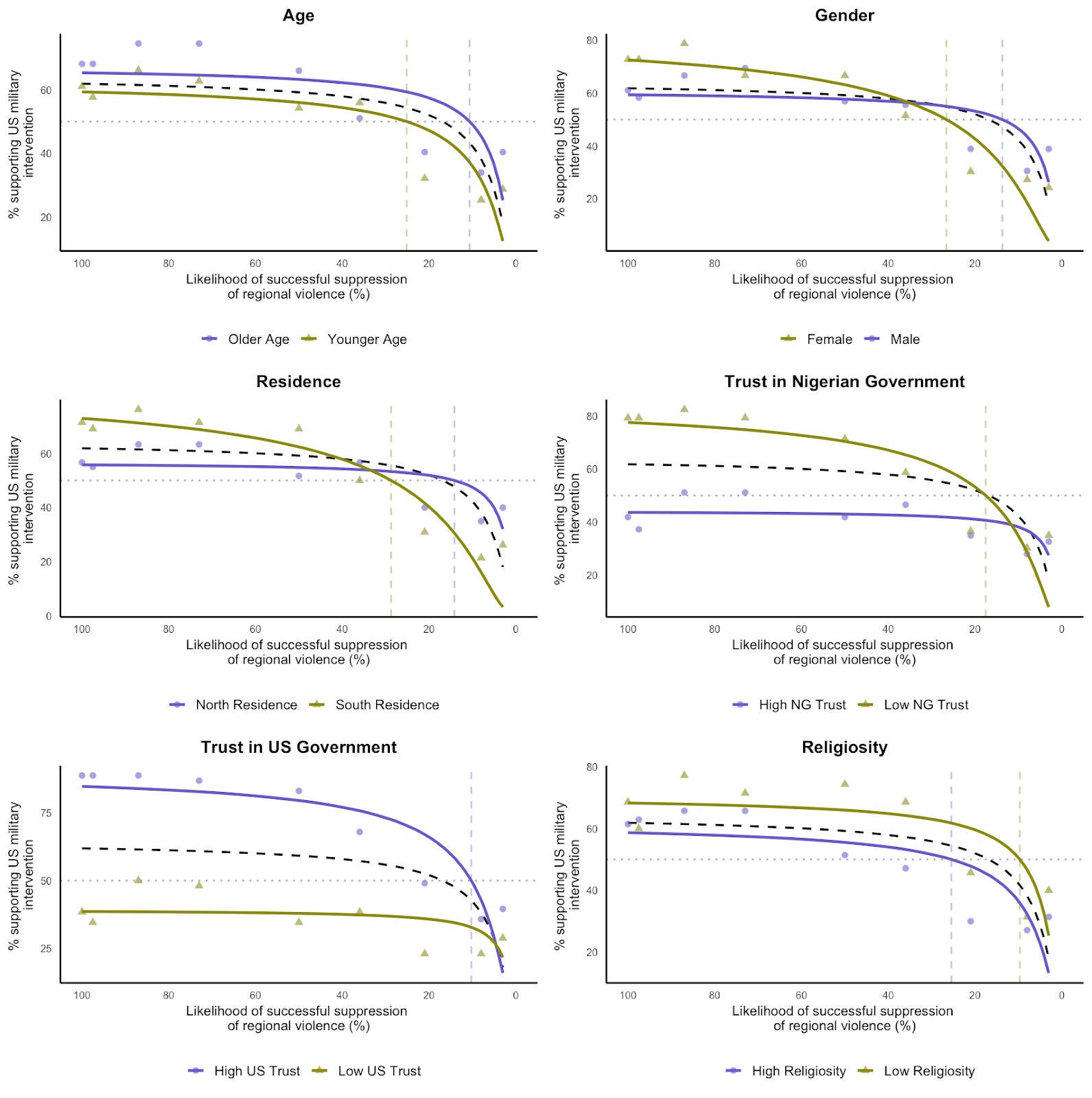
Age: The older participants seemed more tolerant of an unsuccessful intervention (P50 = 10.65%) compared to the younger participants (P50 = 25.15%). Also note how the curve for the older subgroup is consistently higher than that of the younger subgroup at all likelihood levels. This may be expected at higher likelihoods of success but is definitely surprising at the lower likelihoods. Older people tend to be risk averse and supportive of outcomes that are certain. You would also expect older people to have a lower demand because they should be able to recall stories of past US military intervention in other countries that went sideways. Yet, the response patterns of older people in this study suggests that the regional violence in Nigeria may be so salient in the minds of the older respondents to the point that it is changing their risk profile.
Gender: At high likelihoods of success, female participants appear to have a higher demand than males. However, as the likelihood of successful outcomes start dipping, female demand also tanks more sharply. Note how the two curves cross at lower likelihoods of success leading to male participants having a lower P50 of 13.71% compared to females’ P50 of 26.61%. This observation may reflect men’s general tendency towards risk seeking. It is also possible it’s just an artifact of our sample composition (about 67% male respondents).
Region of residence: Most of the violence we hear about in the news is taking place in the northern part of Nigeria. So it was really interesting that at higher likelihoods of success, southern residents (about 39% of the respondents) had a higher demand than northern residents. That said, at lower likelihoods of success, the curves cross with northern residents having a P50 of 14.15% compared to the southerners’ P50 of 28.75%. This pattern mirrors the age observation – when you are in a dire situation, you are more open to uncertain outcomes if it has the most remote chance of making things better. Northern residents are closer to the violence and seem willing to tolerate an intervention with remote chances of succeeding.
Trust in the Nigerian and US governments: This is straightforward – there seems to be some overlap between those who have a high trust in the US government (about 50% of our sample) and those who have a low trust in the Nigerian government (about 59% of our sample). Hence it is not too surprising that the demand curves show that those with high trust in the US (P50 = 10.26%) and low trust in Nigeria (P50 = 17.54%) were more tolerant of a US military intervention with remote chances of succeeding than those who have high trust in the Nigerian government and low trust in the US government.
Religion: Religion plays a big part in the day-to-day lives of Nigerians, so, it was a bit difficult to split our participants into ‘high religiosity’ and ‘low religiosity’. We pulled it off by categorizing only those in the bottom 25% of perceived personal religiosity as ‘low’ (about one-third of respondents) and all others as ‘high’. That said, it was quite interesting that those in the low religiosity subgroup had higher demand for US military intervention at all likelihood levels. They were also more tolerant of a US military intervention with remote chances of succeeding (Low religiosity P50 = 9.68% vs High religiosity P50 = 25.47%). Perhaps the high religiosity subgroup do not think it is responsible to support a US military intervention if it is clear from the onset that it has a small chance of succeeding. Yet, that may only explain the differing P50s but not the lower demand found in the high religiosity subgroup at all levels.
Insights from Nigerian Interviews
We anticipated that demand would vary with the characteristics of the different participants in our sample. However, we wanted to find out if there were other factors at play that we hadn’t considered in our survey.
To get to the root of this, we asked those who had completed our survey if they were interested in being interviewed. We got an overwhelming response, and consequently, because of capacity, we invited 12 people (2 from each of Nigeria’s 6 geopolitical zones) to be interviewed. Because a couple of weeks had passed since the initial study, our team had these 12 participants take the same short survey again before we started asking them to share the rationale behind their choices.
Before we go over their responses, the figure below shows the response pattern of the 12 participants we interviewed.
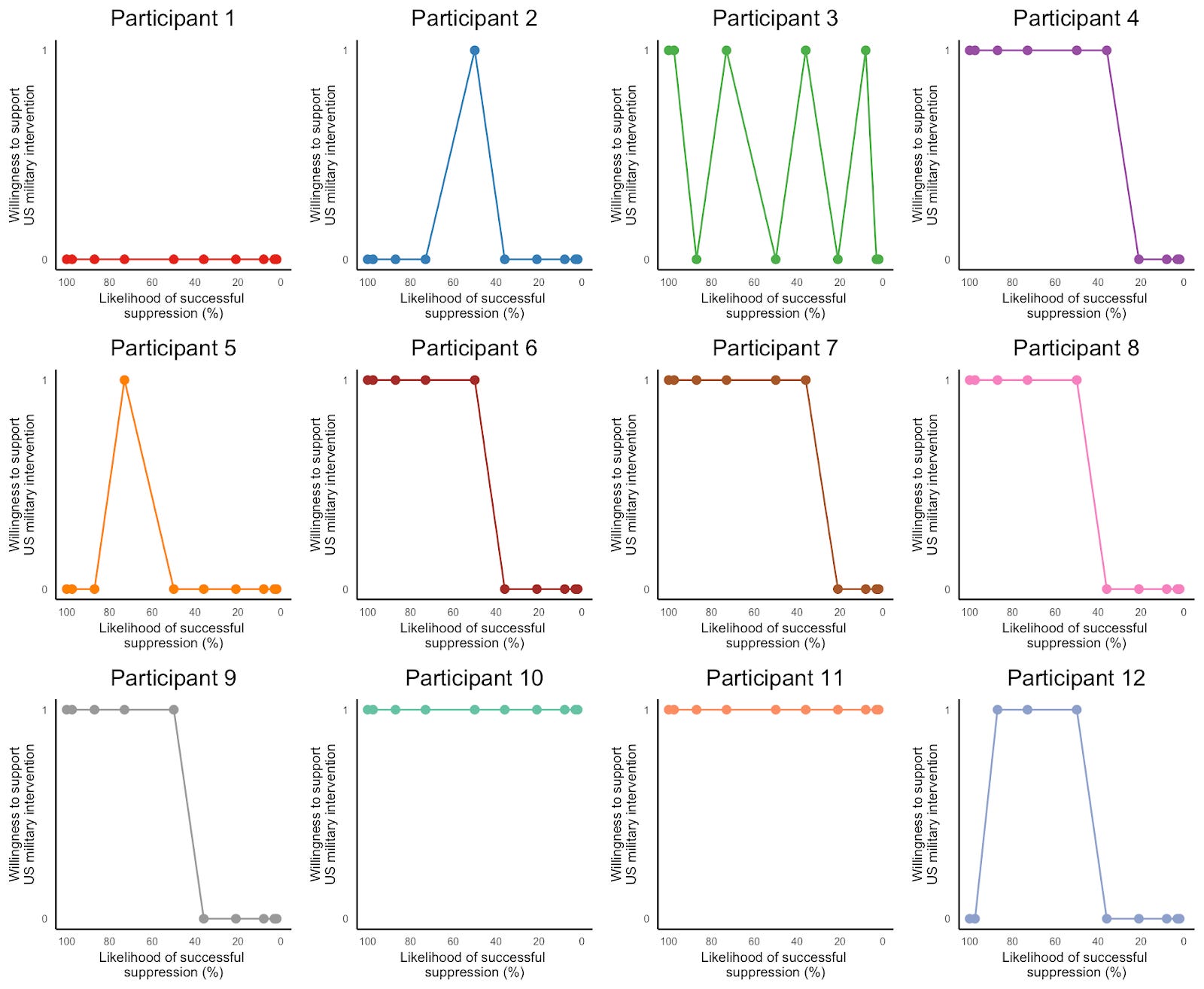
First, let’s address the weirder demand patterns from the figure above. Participants 2, 3, 5, and to a smaller extent, 12, responded in an inconsistent manner. On a first glance, it might appear as though they either didn’t understand the survey, or were just inattentively responding to it haphazardly. However, our conversations with them revealed more nuance:
Participant 2 seemed to have interpreted the survey as asking about broad support for US military intervention, rather than support conditional on a range of likelihoods of successful outcomes from said intervention. When probed about his response, he said: “At 50%, an even chance, I will not support a full US military intervention because the outcome is uncertain, and I do not believe foreign intervention is the right solution for the interreligious violence. I only support limited US cooperation to help fight banditry and Boko Haram, not a broad intervention. ”
Participant 3 also seemed to have misinterpreted the survey, which is at least partly responsible for the haphazard vacillation between ‘Yes’ and ’No’ throughout all the likelihood options presented. When probed, she said: “Okay, I supported 97% likelihood of successful outcomes actually. But, you know...the system of politics in the country is different. I’m not really…politically inclined, but I still feel like whatever the Nigerian government decides on will stand. I’ve said what I feel about the US military intervention…maybe ignorantly, or based on how I feel about it, but then politically it might not be that same way.”
Participant 5’s single ‘Yes’ appears to be due to inattention. When probed, she said: “I rejected it completely; I see no reason that another country will enter our country to solve our own problem…This is our country, and the people living here are the ones that know our problem – even the criminals that are doing all these things, we are the ones that know them. When another country intervenes in our country, I do not think they can differentiate between the people giving us this problem and the people of the country. It is only the people living in that settlement or area that can differentiate between the original Fulani and the criminals.”
Participant 12 responded ‘No’ to the first three likelihoods of success. This was an intentional decision. Here’s the response provided when probed: “How sure are we that the US will only focus on the bandits or the kidnappers, and all those hoodlums that are committing all these atrocities? How are we sure? But we know that with the US technical capabilities, yes, they can attain 70% likelihood of successful outcomes. That is why I abandoned all higher likelihoods of success in the survey and started with 70%.”
Nigerians’ Thoughts on the Actual Root Cause of Violence
We wanted to find out if participants thought the killings going on in northern and central Nigeria were accurately framed as ‘inter-religious violence’, or if there was something else going on.
Religious Factors
Christian respondents (Participants 4, 8, 10 and 11) were quite confident that the regional violence in Nigeria had religious undertones. Participant 11 stated: “The aim of the perpetrators of regional violence is the same thing…just like Hamas, Hezbollah, and other terrorist organizations….This is about targeting the Christians. Sometimes, they make people feel as if it is not what it is….It was not just about the herders and the farmers. It is about facing the community dominated by the Christians – killing them…. If the violence is not because of religion, why are they shouting “Allah Akbar” before they kill Christians?”
Participant 8 acknowledged the complexity of the situation, noting: “Religion is a major player in this whole violence. However, it is a multi-headed beast, with other issues such as politics, tribalism, and people using regional violence as a cover for illegal mining and weaponry trade...But the real driving motive is still the fact that they think: ‘You are an infidel…I have been given this land, I have the power to overcome you, and I can destroy you and your people.’”
Muslim respondents (Participants 1, 2 and 5) largely rejected the religious framing of the violence. Participant 1 argued that the problem was governance, not religion: “The problem we have in this country is bad leadership; that is just the only thing we have in this country... If not, we have what it takes to fix this country….There are some leaders in this country that they are hiding under the umbrella of these religions….If not, Muslims and Christians are just like one in the country.”
Participant 2 identified deeper structural issues with religion only playing a mobilizing force, noting: “Even though people call it interreligious violence, the complaint is not truly about Islam and Christianity. Instead, it is often caused by non-religious factors such as…struggles over farm land, grazing roads, and water, climate change, reducing land availability, and competition for resources. And there is ethnic identity differences: Fulani versus non-Fulani communities, Hausas versus other ethnic groups. Religion is only used as a lever. The real issues are ethnic and social. There is also political manipulation. Politicians use religion to mobilize supporters. They turn local disputes into Muslim versus Christian to gain power, you understand?”
Participant 5 attributed the violence to illiteracy, saying: “This violence is not related to religion or any other thing like that, because when these people doing this violence come out to carry out their operation, they are not considering any religion, they are not checking to see if this group is Christian or Muslim….They do not care about any religion; they touch everyone, they kill everyone….One of the major reasons for this is illiteracy. Because there is no way a literate person will start killing people without any strong reason.”
Multiple respondents (Participants 3, 9 and 12), for their part, believed the regional violence is intentionally sustained by the elite for economic and/or political gain. Participant 9 explained: “There are some elites in the North that are using regional violence as a source of income, and there are some political people using it as a source of achieving their aim in the system. So, that’s the truth. There are some people benefitting from it whether you like it not; there some people using it as an arm for themselves to succeed or to key into the system”
Participant 3 shared the same sentiment about political actors benefiting from prolonged instability: “I feel like it’s an interreligious violence…and there’s a political something attached to it….Politicians in this country can just do and undo…Whenever there is a high rate of insecurity in the country, they tend to gain more and make money from it. So, this regional violence can also be as a result of the politicians using the perpetrators to cause chaos in the country, and after that, they are earning from it.”
When we probed further about the structural/infrastructural contributors to the regional violence, respondents had mixed opinions:
Population Growth
On population growth, Participant 1 connected high birth rates with vulnerability to radicalization: “Actually, being a Muslim, you are entitled to four wives. But it is not mandatory... And what we now understand in the far north is that most of them, they get married to two, three, four wives and have a lot of kids, which they can’t even feed, talk more of their education…How do you feel like if your father gave birth to you, and maybe you people are maybe 10 or 15 children in total. Your father did not take you to any primary school... you grew up in the street, fending for yourself daily... And you got someone that took you into a hotel room and says, ‘Okay, I will give you five million naira. This is a time bomb. Go to so-so location and bomb yourself with it.’ Does that person have an option? He doesn’t even know the implications... To him, his life is useless.”
However, other participants disagreed with the idea of population size as a contributor to regional violence. Participant 4 questioned the premise, stating: “Show me the statistics supporting the claim that northern Nigeria is increasing in number. No, I do not think the increase in population has anything to do with the increase in violence.” Participant 9 also argued that the problem was elite leadership, and not population: “It is not the increase in population that increased the violence. It is the elites in the North that are supposed to enlighten their people and lead them. There is one thing about the North: whatever the elites want them to do, that is what they are doing. The increase is not what causes the problem at all. They have the land mass that can accommodate them.”
Climate and Environmental Stressors
The contribution of climatic and environmental factors also divided opinions. Participant 8, for instance, acknowledged climate pressures in northern Nigeria while also emphasizing the need to adapt: “We can’t deny the fact that climate change is happening, and there is an increase in population and migration... However, as things and times are changing, you don’t keep alien practices due to climate change. If what you have been doing is pasture rearing, moving from place to place, forest to forest, everybody knows that the modern farming method for cattle rearing is to have ranches... Ranching is going to solve the farmer-herders’ clash”
Participant 7 also saw environmental stressors creating conditions for regional violence: “I think environmental factors influence violence because there is usually unrest when there are environmental issues.… When people are looking for a water source and what not, it could result in stealing which, in turn, results in different forms of violence….These environmental issues also lead to low produce output, and then it will definitely lead to stealing. And that can be a form of violence that can cause unrest in the communities there.”
However many respondents rejected environmental conditions as a factor contributing to violence. Participant 5 noted: “To me, that’s not true that environmental factors lead to violence. Because this is not the first time we have been facing this shortage of rainfall. This is something natural. During the olden days when we faced this kind of shortage of rainfall problem, nothing like this regional violence happened.” Participant 4 compared Nigeria to other geographical regions with similar environmental conditions: “I’m part of those people that do not believe that climate change has anything to do with the violence that we are seeing in northern Nigeria... So, if we are seeing such violence in northern Nigeria, why are we not seeing other countries around northern Africa also having this same problem? Why is climate change, desertification, and the rest not causing northern African countries to have the same issue as we do in Nigeria. So, that is not a reason. And besides…it is not that people are moving to settle somewhere or killing people because of the resources that those people have. Rather, we see mostly ethnic cleansing and religious attacks, so it has nothing to do with climate change”
Nigerians’ Stance on US military intervention
Two interviewees provided unconditional support for US military intervention in Nigeria. Both were Christians from northeastern Nigeria where much of the regional violence takes place. Participant 10 said: “It would be great if the US can help us stop this violence by coming to Nigeria. There are many groups in Nigeria that are willing to finish all the Christians in the entire nation or entire region. Like these bandits, Boko Haram, they are all there. They are hunting believers, hunting them like animals. I lost one of my closest brothers, the same mother, the same father. They killed him. It was a Fulani herdsman. They killed him just for nothing. He had a family. All those things that we are seeing are happening in real life. Seriously, this is a very sad situation.” Participant 11 also expressed desperation for outside help, saying: “Looking at the security problem we have, most especially in the northern parts of Nigeria, it has not been easy for everyone who stays in the northern part of Nigeria. We are facing a crisis, and we have cried and cried. No one heard our voice. They will only come and make promises, and in the end, nothing will be done. People are dying every day. We’ve lost confidence in our securities. Our local vigilantes are not strong enough to protect us. We rely on prayers and also rely on God. When we heard the news or rumors of the US intervening, it was like heaven on earth to us.”
Some respondents supported the intervention conditionally, switching from ‘Yes’ to ’No’ as the likelihood of successful outcomes dropped. Participant 12 noted: “If we are to call a spade a spade, people whom the US has come to their aid have not recorded being helped without offering more to the US…We know the state of Libya today. Help was promised to them, and all of that. Even if we look at the US military intervention as a religious matter, that they are coming with the aim of helping the Christians, a concrete agreement should be drawn. Both sides should go to the drawing board and define: this is what we want from you, and this is what we are giving in return. Let it not be on a platter of gold that we are thinking that they are coming to help a country just like that....As the saying goes, nothing goes for nothing.” Participant 6 provided conditional support for other reasons: “Well, I know the country that I am in. I know Nigeria as a whole might not want the intervention. But as a first thing, I believe that the intervention will really help.”
Two interviewees, both Muslims from northern Nigeria, rejected any form of US military intervention. Participant 1 feared the consequences: “I rejected everything. I’ll never support the intervention of a foreign country coming to Nigeria…You know, if military intervention comes to Nigeria now, we will just have to start afresh. You will never pray for a war because the intervention will definitely lead to war.” Participant 5, also rejected US military intervention out of fears of foreigners being unable to distinguish between criminals and civilians: “When another country intervenes in our country, I do not think they can differentiate between the people giving us this problem and the people of the country. It is only the people living in that settlement or area that can differentiate between the original Fulani and the criminals.”
Nigerians’ Thoughts about Military Alternatives to US Intervention
We then asked the interviewees how they would feel if alternative interveners were deployed to counter the regional violence instead of the US military.
The Nigerian Military
When the alternative was the Nigerian military, only Participants 1 and 5 showed a full preference for this option. Participant 1 noted: “The Nigerian military already knows what the problem is and they know what it takes to do it. If eventually they have what it takes to do it. They know what they need to solve the problem if it’s available…That’s what they are trained for.” Similarly, Participant 5 stated: “I’ll strongly accept Nigerian military intervention. They are the ones that are supposed to fight it for us because they are the ones in charge of our safety. When they decide to fight this battle, that is a very good idea. I will strongly support it because they know who to protect.”
However, many respondents believed that the Nigerian military is infiltrated and compromised. Participant 9 stated: “Nigerian military cannot intervene. Let me sincerely say it, because as soon as they make a decision in-house, the decision is immediately echoing in the bandits’ camp…. So, they cannot solve it, seriously. There is no way they can solve it.” In the same vein, Participant 7 alleged to have seen evidence of compromise: “I believe that the Nigerian military is corrupted. I have seen videos of the army in the frontlines of the battlefield, and then they find this insurgency, and then when they are about to maybe eliminate them, they get an order that, ‘Cease fire, don’t do anything to them, get back.’ So, it’s like, why? Why is that? We’ve had reports of it happening over and over again. So, I believe that the Nigerian military is compromised.”
Participant 10 pointed out resource diversion as a constraint on the Nigerian military’s effectiveness: “The Nigerian government has what it takes to handle this, but the truth is that bad governance prevents that from happening. They will carry things that they are supposed to give soldiers and give it to bandits. That’s the issue. They know that what these bandits carry, you cannot carry it as a soldier. They will give you 30 bullets. You are told to go and fight bandits. How will you fight bandits? We have the equipment, but the Nigerian government diverts it.”
Participant 8 identified internal betrayal as another limit on the Nigerian military’s capabilities: “If the military decides and chooses that they are going to end this, I believe the Nigerian military could have largely done it. But I believe the Nigerian military has been sold out already. There are a lot of people among them that might be leaking things to these terrorists, and that has made their fight ineffective. There was a time we saw a video in circulation that one of them was selling weaponry to these terrorists. Because of the many internal issues within the Nigerian military itself in combating the insecurity, I won’t trust it holistically the way it is as of now to combat insecurity.”
Local Vigilante Groups
Local vigilante groups, on the other hand, received sympathetic views from some respondents. Participant 7 saw them as essential for early warning and rapid response: “I will actually accept local community vigilante groups for warning and early detection but they will have to work with the Nigerian military. The local vigilante groups are more knowledgeable about their communities and they will be in the best position to know when something is off like if there’s a breach of our security. They have to be given more resources, more capacity, so that they can actually do better or protect the community well. They respond faster than the Nigerian military.”
Participant 10 also praised their motivation, seeing their ‘skin in the game’ as a big contributor to their effectiveness: “Vigilantes are trying their best. If the Nigerian military can join hands with vigilantes, I think that will help a lot. They don’t earn any salary, but they are doing their best to protect the community and the local villages in terms of thieves. Despite the fact that they don’t have weapons to fight, their presence matters a lot. They don’t accept anything like corruption. The vigilante is a farmer. He is trying to protect his farm from these Fulani herdsmen and bandits. They are well organized in terms of fighting or securing life and properties. You are not paying them salary, so you cannot give them any order.”
Participant 10 went on to share a concrete example: “I have five of my friends that are working with a group we call in our area ‘No English’. They are not educated, but they protect our community with their own lives. The bandits once cut off one woman’s hand in her farm around midnight. The police refused to go because they said they don’t have fuel for their own bike. The community people called the ‘No English’ group. At midnight, more than eight of them went there on machines (motorcycles). They apprehended the fellow that cut her hand.”
However, other respondents were less enthusiastic. Participant 5 was skeptical that local vigilante groups could handle serious threats: “Actually, no I don’t support vigilante groups. Because the perpetrators of the regional violence will end up killing all of them. Vigilante groups can never handle this situation. They can never because they don’t have what it takes to even confront these people. On the other hand, when we talk about the Nigerian military, we are talking about people that are professional. They are well-trained.” Participant 11 also noted the limitations of the vigilante groups: “Those local vigilante groups are really trying their best, but they don’t have the training. No skills, no strong weapons to face those bandits. If the terrorists attack them, they kill them in numbers because they are not well-trained. So, for them, they are only trying to alert the people to find safety, to reduce the casualties. I don’t think they can help.”
Nigerian Thoughts about Non-military Alternatives to US Intervention
As a way to wrap up the interviews, we asked the participants “If you had ₦100 million (about $70,000) to spend on reducing violence in northern Nigeria, what would you do with it?” This was to get at other interventions they deemed important but didn’t come up in our line of questioning.
Employment
A good number of our respondents felt that regional violence in northern Nigeria was driven by poverty, hunger, and a lack of economic opportunities. Thus, if resources were allocated towards creating jobs, youths vulnerable to recruitment into violent groups would not see any incentives for resorting to violence. Participant 1 focused on agricultural employment: “Here’s what I would do: I’ll go into crop production. There should be food everywhere. Just grow crops everywhere, food everywhere. I will engage the vulnerable youth into one thing or the other related to agriculture. Come into the farm.…We can do it. With ₦100 million we don’t even need the government to set up farms for us. We can do it ourselves.”
Participant 7 said: “For me, first and foremost is, you know, reducing poverty. I believe that these extremists and these insurgents are involved in such activities because of poverty. So, if there could be interventions that will help train people with different things that will build their capacity to become entrepreneurs and responsible, that would be what I would put the 100 million into.”
Dialogue
Participant 5 took a more controversial approach, suggesting direct engagement with the perpetrators: “I will try to communicate with the criminals, because there must be a way of communication between the criminals and the government. I will go to them and I will like to know the main reason why they are killing and maybe if it’s possible, I will provide a good shelter for them or a salary, even without working, every month, so that they will go back to their homes. They will repent, stop the killings and live their lives comfortably because actually, they are not comfortable living in the bush.”
Local Community Structures
Given their distrust in the Nigerian military, many respondents expressed a preference towards allocating resources directly towards local community structures. Participant 10 noted: “I have five of my friends that are working with a local community vigilante group. The way we call them in our area is ‘No English’. If I have access to resources, I will focus on those people and make sure I give them proper training. Number one, give them weapons. Number two, show them the value of that community or the people you are protecting. I will make sure I empower them, giving them maximum support, like machines (motorcycles). I’ll make sure that in any village, if anything happens, before they call the police, they call that local community vigilante first. They are ready to go anytime you call them.” Participant 11 also agreed: “If I have the 100 million naira, I would rather use that money to strengthen the local vigilante groups, irrespective of where the person comes from or who the person is. Just give the person training and discipline.”
Strengthening Legal and Judicial Infrastructure
Other respondents identified investments in the rule of law as the top priority for curtailing regional violence in Nigeria. Participant 4 stressed funding prosecutions: “I think what I would do with it is hire a lot of lawyers that are going to prosecute people who contribute to this evil act and bring them to justice. At least, giving people who have lost loved ones to regional violence justice will grant them some sort of humanity. They will not be as angry as they are now. They will see that the government is doing something about regional violence. And also maybe file cases against people who are being released from banditry charges easily.”
While seeing the value of investments in the rule of law, Participant 8 did not think there was sufficient will among the political elite to see it through: “I don’t think money is the major challenge to reducing insecurity in Nigeria now. We can gather intelligence and find out about people who are complicit, but if we are unwilling to prosecute such people, they will still be walking around the street. In addition to having the money to gather intelligence, being in a position of governmental power to prosecute people would really go a long way, even more than the money. More importantly, 100 million naira is enough to buy armaments, intelligence, and also have government support to prosecute people who are complicit, in addition to spending the 100 million naira for intelligence gathering.”
Policy-Relevant Considerations
Although our sample size was small, the findings from this study highlight a number of considerations:
First, we need to move beyond binary intervention debates. Out of the 106 people we surveyed, only about 35% consistently chose either all ‘No’ or all ‘Yes’ across all likelihood levels for US military intervention. The majority of our respondents, instead, showed support for US military intervention given certain conditions. This ranged from a high likelihood of successfully suppressing regional violence to the form of intervention provided, such as offering technological support and collaborating with the Nigerian military. While our sample size limits generalization, the geopolitical composition of our sample (56% northern residents vs 39% southern residents) provides some regional representation and we believe it is plausible that this graded, conditional support for US military intervention mirrors how most Nigerians actually think about this issue.
Second, there is no shared consensus about the religious framing of the regional violence in Nigeria. Although Christian interviewees generally endorsed the religious framing of the violence, and the Muslim participants mostly rejected it, many participants also agreed that there were structural factors such as poverty, poor governance, and political manipulations driving people towards perpetrating regional violence. Consequently, this suggests that exclusively framing the regional violence in Nigeria as religious persecution or inter-religious conflict may only bring about more division which could divert attention from the real root causes and their potential solutions.
Third, even among respondents who expressed relatively high trust in the Nigerian government or low trust in the US government, interviews revealed a general distrust of Nigerian institutions which took different forms. Some participants described relatively benign distrust rooted in technical and infrastructure constraints on the effectiveness of Nigerian institutions, while others had a deeper distrust of the military/political/bureaucratic elite grounded in perceptions of corruption and collusion. These findings suggest that the Nigerian government has a lot of work to do to rebuild public trust in its institutions. Efforts to improve accountability among the political and military elites, increasing transparency into government spending through open and verifiable databases, and visibly prosecuting individuals complicit in violence would likely signal a stronger commitment to the rule of law which will translate to increased public trust. Sustained investments in poverty alleviation, education, and literacy programs will also increase trust in the long run
Finally, the relatively high level of trust in local vigilante groups has pros and cons. These vigilantes are familiar with the local terrain and have a personal stake in the safety of their communities which incentivizes them to respond to threats quickly. Yet, as the interviews revealed, the vigilantes are often ill-equipped to counter better-armed terrorists. Besides, what is to stop armed vigilantes from extracting rent in the form of ‘protection’ money from the locals? In this case, the Nigerian government will have to take a bar-bell approach that requires investments in both ends of the security spectrum. On one end, there should be investments made towards professionalizing the Nigerian military, police and other public safety arms in the country. This is a long-term vision which requires sustained investments and changes won’t happen overnight. On the other end, where the local vigilantes already operate, there needs to be semi-formal oversight mechanisms to prevent abuse. Someone shouldn’t be able to just randomly pick a cutlass and claim to be a vigilante. These mechanisms may include simple registration systems that document who is authorized to serve as a vigilante, basic training programs on rules of engagement and legal constraints, simple identification systems for accountability, and minimal codes of conduct enforced through community oversight. Once the more formal public safety systems have been professionalized and regained legitimacy, semi-formal partnerships between the local police and the local vigilantes can then be established which could lead to the latter gradually integrated into the former.