

There was a ruckus in the African corner of Twitter sometime in the Fall of 2024. A Nigerian user went viral from publicly pontificating on why countries that had snowy winters also seemed to be more economically developed. Seeing the increasing engagement, and the potential dollars rolling in from Elon Musk’s Creator Revenue Sharing model, this user doubled down.
I’m going to attempt to steelman him here: Basically, according to his theory, the extremely cold and snowy conditions in North America and Western Europe forced the locals to think about creative ways to survive in their harsh environments, which facilitated a lot of innovation and creativity. This, in turn, had the spillover effect of better coordination and organization which created the conditions for economic development. In contrast, less economically developed societies, particularly those in Africa, have been historically blessed with a mostly favorable climate and abundant natural resources. This made the locals complacent and unwilling to push themselves to be innovative and creative, and this is why Africa continues to languish in underdevelopment today.
I was appalled by the tens of thousands of likes, retweets and favorable comments this post got. Many contemporary Africans tend to see the West as the standard of civilization and civility, which unfortunately perpetuates subtle hints of inferiority and self-loathing1 felt both online and offline. I’m fortunate to have lived, at some point in my life, in Africa, North America and Western Europe. And one thing that has stood out to me is that, at a fundamental level, “humanness” is essentially the same everywhere - regardless of nationality, geography, language, or skin tone. There’s nothing innate about the people living in the West that makes them superior to their African counterparts. There are idiots in Africa, North America and Western Europe, just as there are incredibly smart people living in these same regions. Corruption exists in Africa, just as it does in North America and Western Europe. As the cliche goes, “Geography isn’t destiny,” and no one region has a monopoly on stupidity and corruption.
To pooh-pooh on his theory, I cited how it snows in both Mongolia2 and Kyrgyzstan,3 yet, they are not particularly known as paragons of economic growth. I also shared how I had been to El Paso, a city on the US-side of the US-Mexico border, and Juarez, a Mexican town on the Mexico-side of the border. Both towns have similar geographies, similar climates, and are less than an hour’s drive away from each other. Yet, because they are under different national governments, they have very different levels of economic development. At the end of the day, I posited, the main difference between the economically developed nations of North America and Western Europe versus those of Africa was the kinds of institutions at play. If we wanted to change Africa’s fate, we needed to change the way its bureaucratic, economic, legal, and political institutions functioned.
I was smugly satisfied with my dunk, left it like that, and moved on with my life.
My Introduction to Cultural Materialism
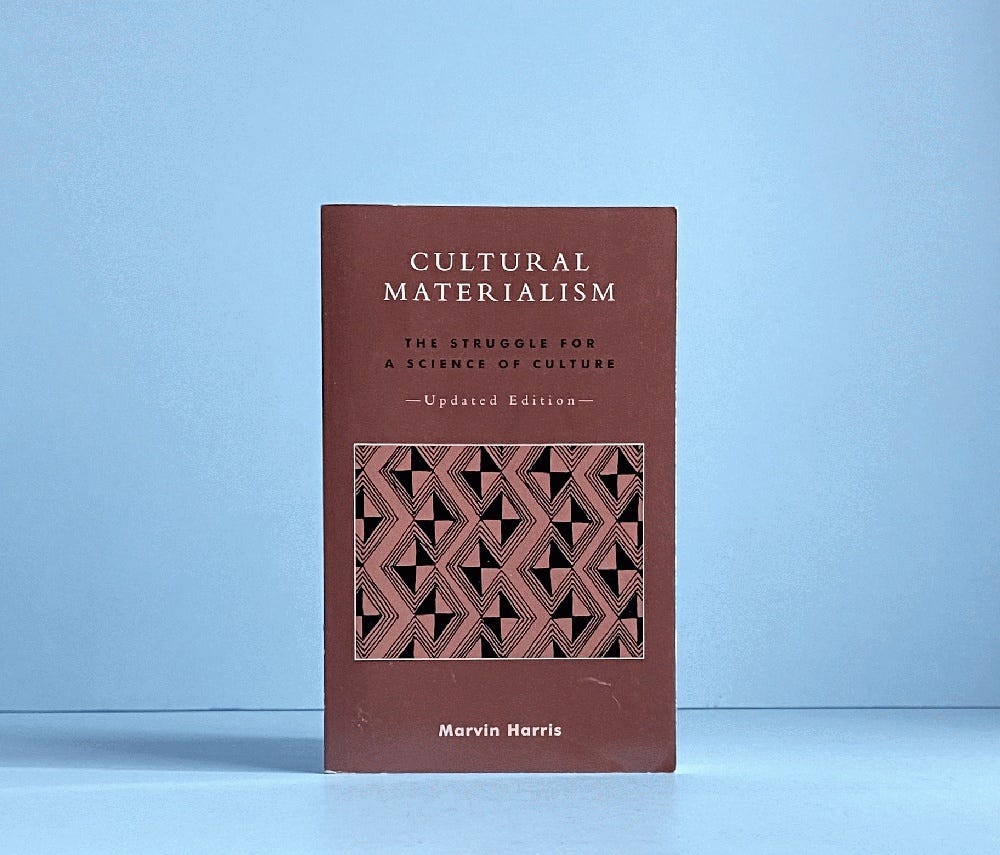
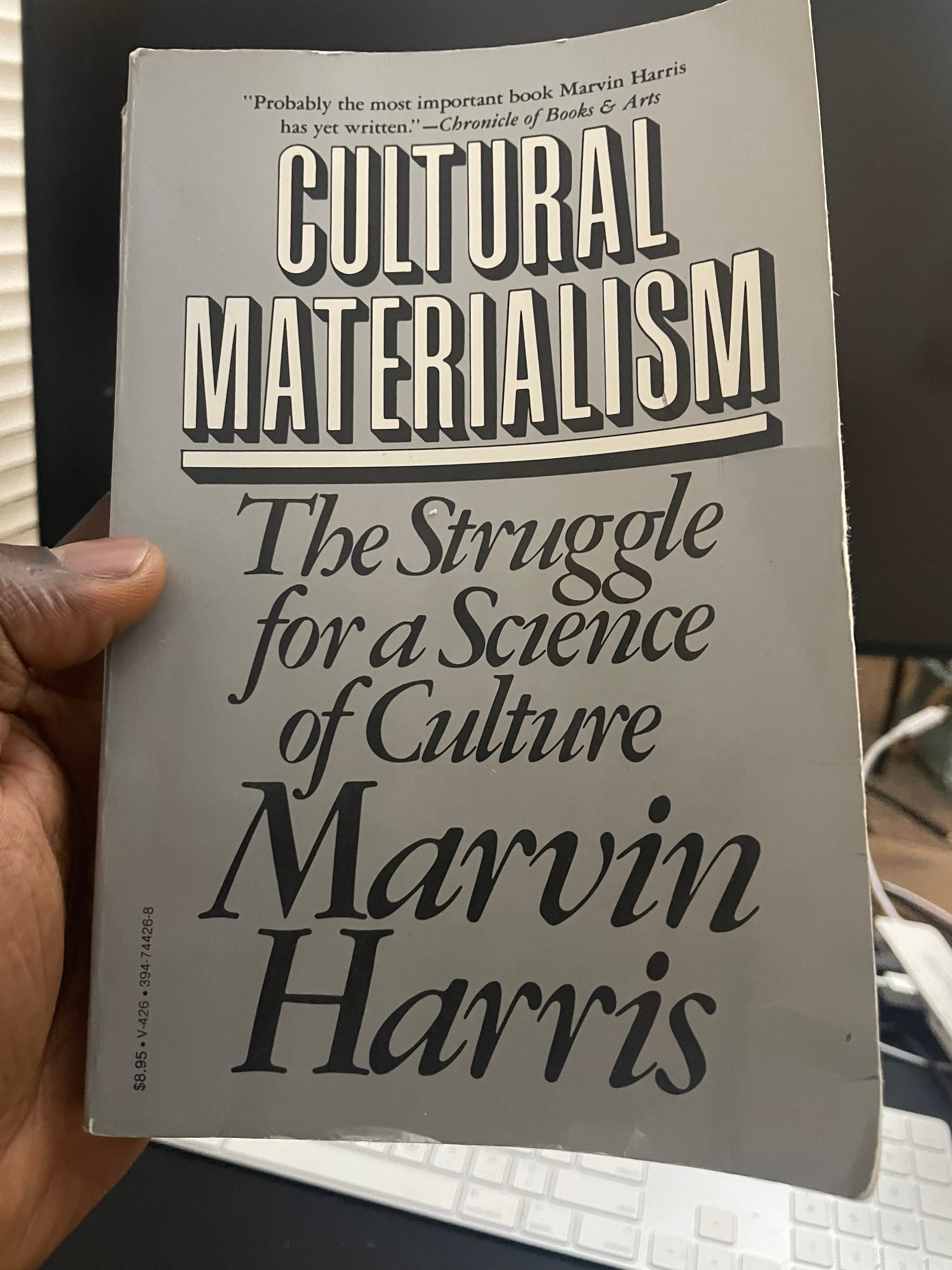
Back when I was in grad school (circa 2022), my PhD advisor had suggested I read a 1979 book written by the American anthropologist Marvin Harris, called “Cultural Materialism: The Struggle for a Science of Culture.” I had bought the book a year later, but never got to reading it due to the million other things I was reading at the time to get my dissertation done and get my doctorate.
This year, I finally picked it up. Not because I had the extra bandwidth to do so after meeting the demands of my 9-to-5 and doing behavioral science research at PROMISE Labs Africa. Rather, at that point, I had started feeling that my position of seeing weak institutions as the sole cause of Africa’s predicaments was at best incomplete. Prior to gaining independence from European colonialists in the 1950s and 1960s, for instance, some African nations had been “set up”4 with the bureaucratic institutions that could give the semblance of a functioning democracy, such as a literate civil service, an elected legislature, legal codes, political parties and a police force. Yet, in less than 10 years or so, everything came crashing down, with many of these African states falling under decades of military rule or authoritarian control. As it turns out, institutions may not be the be-all and end-all of economic development that they’re touted to be.
In Cultural Materialism, Marvin Harris offers a more complete framework5 that could be used to both understand and analyze different societal systems. Its three key levers are:
Platforms: These are the observable material conditions that make social life even possible in the first place.6 The actual word Harris uses is infrastructure, but I prefer platforms as it unambiguously connotes a kind of foundation upon which everything else is built. Harris subdivides this lever further into modes of production,7 which deals with the different types of tools, technologies and labor used to produce food and energy; and modes of reproduction,8 which comprises of factors that directly affect a society’s population, such as age and gender distributions, birth and mortality rates, as well as technologies for controlling population, e.g., contraception. Harris also considers ecological and environmental factors, including climatic conditions, and the kinds of plant and animal species that can breed in an area, as core components of the modes of production.
Protocols: These are the different formal and informal rules and arrangements that shape how people in a society interact, coordinate and organize themselves. In his taxonomy, Harris uses the word structure, but I went with protocols (h/t Venkatesh Rao) to make this lever more resonant with the examples it contains. Harris further divides protocols into two subcategories: domestic economy, which is concerned with rules of coordination in a domestic setting (e.g., family size, marriage structure, age and gender roles); and, political economy, which focuses on the formal and informal rules of coordination within and between larger societal units like clans, villages, states, and empires (e.g., taxation systems, land tenure, norms about class/caste hierarchies, codified laws).
Paradigms: These are the different ideas, values, meanings, philosophies and beliefs that shape and constrain individual and group preferences.9 As I am wont to do, I have replaced superstructure, the term that Harris uses for this lever, with paradigms, which is a word everyone easily associates with worldviews.
How the Levers Interact
One staple of Cultural Materialism is the idea that causality primarily flows from the platforms to protocols to paradigms. An example Harris provides in the book is how the religious beliefs around abstaining from eating pork evolved in the Near and Middle East. At first, pigs were highly valued as a source of protein and were hunted down for their meat, as they foraged in their natural habitat near forests, river banks, and swamp edges. During the First Agricultural Revolution, however, people in the area started shifting away from nomadic hunter-gathering and towards more sedentary settlements that adopted agricultural practices like large-scale mixed farming and cattle herding. This shift had ecological consequences down the line as larger and larger human settlements caused widespread deforestation in the area, which converted previously forested areas into grasslands and deserts. This meant that there was nowhere for pigs to forage. In these conditions, if pigs were to be domesticated, they had to be fed with cultivated grains, which also reduced the stock available for human consumption. Add to that their need for shade and moisture in an area that was increasingly hot and dry, the costs of domesticating pigs started to outweigh their benefits.
Unlike cattle, sheep and goats, which all can graze the grasslands and provide people with milk, or horses and donkeys that could be ridden and used to plow fields, the only value pigs offer is the delicious taste of its flesh. Considering all these, it is not surprising that societies in the area started developing social norms, and eventually religious taboos banning pork consumption. Interestingly, in forested areas like Ancient Europe and China, there were no taboos surrounding the consumption of pigs because it wasn’t ecologically expensive to do so. Harris called this infrastructural determinism: the kinds of protocols (pork consumption taboos) and paradigms (religious beliefs about pigs being ceremonially unclean) that evolve in a society are constrained by the types of platforms (arid climate, competition of pigs with humans for grains and water) already in place.
This is not to say that innovations and changes at the protocol or paradigm levels do not have any effects at other levels. Harris argues that they do, but they do so in a very specific way. Protocols and paradigms are typically system-maintaining. In other words, any changes to a society at these levels are unlikely to take root unless they are compatible with the underlying platform. As already mentioned earlier, religious beliefs deeming pigs as ceremonially unclean, and taboos surrounding pork consumption didn’t rise in Ancient Europe and China because they weren’t supported by the platform (wet climate, abundance of water, and fertile lands). On the flip side, suppose swine flu breaks out today, public health departments all over the world would place large scale bans on pork consumption, while also updating everyone’s beliefs about the potency of vaccines in preventing infection. That is why in Cultural Materialism, changes in the platform level are likely to reverberate throughout the whole system, while changes at the protocol or paradigm levels can only do so to the extent that they align with the underlying platform.
Why is Africa the Way it is?
So, was that Nigerian Twitter user partly correct? Is it true that snow in North America and Western Europe was a forcing function for adaptation and innovation which eventually created the conditions for the economic growth and societal development in those regions? Is Africa’s fate the way it is today because the climate was favorable and its inhabitants were content to do nothing but eat off the land?
On the surface, Cultural Materialism appears to agree and say ‘Yes’ - after all, climatic conditions are part of the environmental factors at the platform level.
But such an analysis won’t be using the framework to its fullest capabilities. The modes of production and reproduction, for instance, are also platform-level factors that raise questions that need to be addressed, such as, “What kind of work did people do to get food?”, “What types of tools and technologies were available for them to do their work?”, “What types of plants could grow in that region?” or “What was the age and gender distribution of the people living in that region?”
As you grapple with the questions Cultural Materialism forces you to think about, you start to realize that all societies - not just those who lived where it snowed - were actively innovating and adapting to fit the constraints imposed on them by platform-level factors.10 And from these patterns of innovation and adaptation emerged social norms and arrangements, which in turn informed the types of ideas and values that emerge to shape individual- and group-level preferences.
At the end of the day, the biggest lesson from Cultural Materialism is this: if you are tempted to label an action or behavior as ‘bad’ or ‘maladaptive’, you shouldn’t start by asking questions like “Why are these people uncivilized?”, but rather, “What platform-level conditions are they adapting to and what protocol and paradigm levers are perpetuating these?”
Cultural Materialism is neither perfect nor complete by any means. For instance, I still don’t think it fully explains why societies with similar platforms (e.g., the earlier referenced similar geographies and demographic makeup of Juarez and El Paso) may end up developing wildly different protocols and paradigms. The political scientist, Francis Fukuyama, whose book The Origins of Political Order I will be reviewing in the future, flips cultural materialism on its head and proposes that it is the paradigms (i.e., ideas and beliefs such as the rule of law and the protestant ethic) that should take causal priority in explaining why societies are the way they are.
I’m still thinking about where I stand in the debate. Regardless, Cultural Materialism offers a useful starting point for understanding Africa and its socio-economic outcomes, and trying to do something about it.
Thanks to Emily Brooke Felt, Dolores Lucero, Ved Shankar, Lily Luo, Davide Bruzzone, and Justin Tovilode for the conversations and feedback that shaped this essay.
In between drafts for this piece, my Beninois friend, Justin Tovilode, and I were trying to figure out where this inferiority complex came from. Perhaps, we hypothesized, it’s from the impression the first Europeans explorers who touched the sub-Saharan African shoreline might have had on the collective psyche of the coastline Africans. From the latter’s perspective, the Europeans would have looked like pale-skinned, otherworldly individuals that seemed to emerge from the horizon in impressive ships, wearing odd-looking clothes, and bringing different goods like mirrors, rum, fancy fabrics, and later, guns from ‘heaven’ - which is what emerging from and disappearing into the horizon like the sun would have looked like. The first goods the Europeans brought initially served as status symbols consumed only by the local elites. As these goods filtered into the rest of society, there could have been a gradual change in local tastes leading to a devaluation of locally-produced goods and a preference for, first, European goods, and later, European ideas.
“Cold winters are typical in Mongolia. Livestock survive by moving, growing thick coats of fur, and pawing through snow and ice to grasses. But this winter, herds are struggling through both a “white” dzud, in which very deep snow hinders their access to grass, and an “iron” dzud, in which a brief thaw is followed by a rapid, hard freeze, locking pastures in ice.” https://e360.yale.edu/features/mongolia-dzud-climate-change
“We found notable trends to earlier [first date of snow] below 3000 m in western [Kyrgyzstan] and more [snow-covered days] between 1500–3500 m in western [Kyrgyzstan]. We also found the expected notable trends towards earlier [last date of snow] at both oblast and rayon levels. In northwestern [Kyrgyzstan], [duration of the snow season] was notably longer <3000 m, but notably shorter at 3500–4000 m…It revealed more area (106%–130%) trending to earlier [first date of snow] than earlier [last date of snow], reinforcing the counterintuitive finding of longer snow seasons starting earlier at lower elevations.” https://iopscience.iop.org/article/10.1088/1748-9326/ad9c98
Double entendre intended. If pressed, though, I’m not using “set up” in the sense of “properly arranging something to ensure it performs its function,” but rather in the sense of “putting something in a compromised position such that it fails”
Harris’s framework is much more comprehensive than I will be discussing here because he also makes distinctions between emic (insider) and etic (external observer) descriptions, as well as between mental (subjective) and behavioral (objective) phenomena. For pedagogical reasons, I have opted to not go that deep, but to present a lite version of Cultural Materialism that can be easily understood.
For an analysis of platforms leveraging cultural materialism, emic-mental descriptions of phenomena are given less explanatory weight than etic-behavioral descriptions of phenomenon. This makes sense when you consider that stated preference ≠ revealed preference. In other words, people’s explanations for why they do what they do doesn’t match up with the functional or adaptive purposes such actions or behaviors might fulfil.
If you detect some Marxist undertones, you are correct! Karl Marx was one of Marvin Harris’s biggest intellectual influences. That said, Harris departs from Marx by explicitly rejecting Hegelian dialectics as applied by Marx to class struggle, as well as the idea that society was evolving towards some communist utopia
Harris adopted this from Thomas Malthus of Malthusian economics fame, i.e., the idea that population growth outruns food production, and shocks, such as famine, wars, and disease keep the population in check with food production
Although there are etic-behavioral artifacts corresponding with paradigms (e.g., art, symbols, dance, music, religion), I lean more towards emic-mental descriptions when analyzing at this level.
Racists and white supremacists who are quick to pin Africa’s developmental woes on alleged low IQ scores forget that Africans were crisscrossing the Sahara desert for trade for centuries before European contact. Africans also built thriving societies in a tropical climate despite the threats posed by the tse-tse fly (sleeping sickness vector) and the mosquito (malaria vector). Hardly thing a low IQ people would have been able to pull off. In fact, Europeans who attempted to establish settlements in the African interior were often dead within a year. Europeans first made contact with sub-Saharan Africa in the mid-1400s, yet, it wasn’t until the mid-to-late 1800s when the technology of quinine prophylaxis finally allowed them to successfully settle there